Building operational competence in alternative fuels while regulation catches up
June 2026

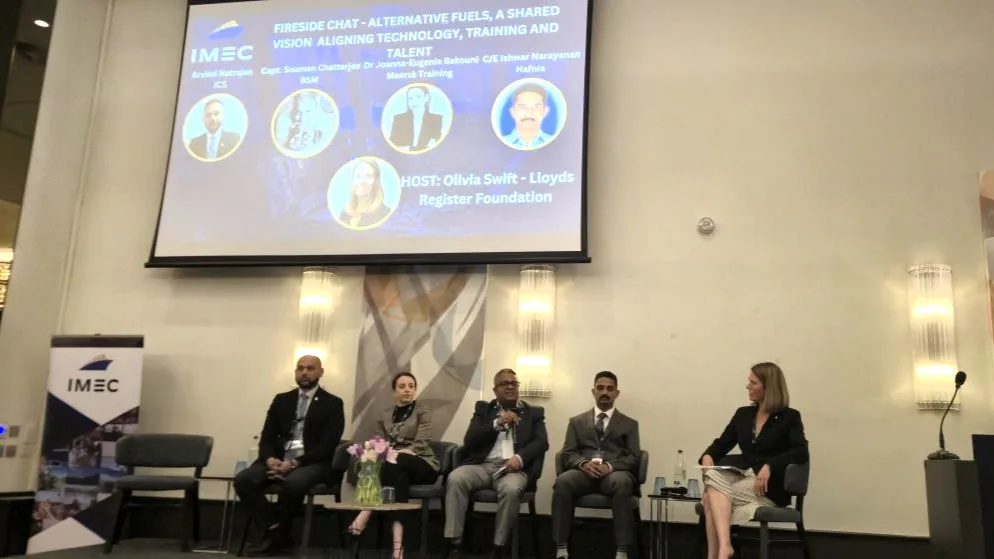
This year we were invited to speak at the IMEC conference in May 2026, on the panel session: "Alternative Fuels, A Shared Vision: Aligning Technology, Training and Talent." First, I would like to thank IMEC for having us and for creating such an important forum to discuss not only the industry's decarbonization goals, but also how we bring people along safely throughout that transition.
I have been turning one thread of that discussion over ever since, because I think it gets less attention than it deserves. When we talk about decarbonising shipping, the conversation drifts almost magnetically towards fuels and machinery.
All of that matters.
But the message we keep hearing from seafarers is not "we cannot learn this." It is closer to "please do not send us into a new operational reality with only generic awareness training, a long manual, and the assumption that experience with conventional fuels transfers automatically."
That gap, between the technology we are deploying and the competence we are building, is the part of the transition we discuss the least and should worry us the most.
Methanol, ammonia, hydrogen, batteries and hybrid systems change the risk picture. Low-flashpoint behaviour, toxicity, cryogenic and high-voltage hazards, different ventilation and gas-detection demands: these reshape how a crew has to recognise a hazard, decide under uncertainty, and communicate when a situation turns abnormal. And the regulatory scaffolding, though it is moving, is still being built around the vessels that are already trading.
The IMO approved its Generic Interim Guidelines on training for seafarers on ships using alternative fuels and new technologies (STCW.7/Circ.25) at MSC 110 issued September 2025, with basic and advanced levels keyed to a seafarer's duties. The fuel-specific guidelines for methanol and ammonia were only finalised at HTW 12 and approved in MSC 111 in May 2026. The Maritime Just Transition Task Force, for its part, launched its first interim training frameworks for ammonia, methanol and hydrogen in September 2025, and has been candid that current STCW competencies do not yet fully cover the skills these fuels demand.
Viewed together, these dates highlight an important sequencing challenge. To make the transition genuinely just, the development of competence frameworks needs to keep pace with the arrival of new vessels and technologies. The interim guidance provides an essential baseline. From there, company-level training plays a critical role in translating that framework into day-to-day operational readiness
So, what does good look like in practice? I find it helps to think in three layers:
-
The first is a foundation level: the common principles around low-flashpoint fuels, toxicity, cryogenic and high-voltage risk, enclosed spaces, ventilation, gas detection, emergency response, human factors and process safety.
-
The second is fuel-specific competence: what is actually different about ammonia versus methanol versus a battery system, where the interim frameworks now give us something to build from.
-
The third is vessel- and role-specific application: what the Master, the Chief Engineer, the ETO, the deck and engine teams, the shore superintendent and the emergency response team each need to do differently.
While we wait for the fuller regulatory picture, I would hold two truths at once.
Yes, the industry needs a more harmonised framework, or we risk every flag state, class society, owner, trainer and manufacturer interpreting competence differently.
But no, waiting for perfect regulation is not an option, because the ships are already moving faster than the regulatory cycle.
The workable path is alignment around the interim frameworks. And that alignment comes in three questions:
-
What competence is required?
-
What evidence proves it?
-
And how operational experience feeds back into the standard?
That is the thought I left the IMEC panel with. Decarbonisation will not be delivered by regulation alone. It will be delivered by people who understand the risks, trust the systems, and are competent to act when things do not go to plan.
For anyone who would like to watch the whole session, the recording is here.
References
-
International Chamber of Shipping (2025) Maritime Just Transition Task Force launches first interim seafarer training frameworks for the use of ammonia, methanol and hydrogen as fuel. Available at: https://www.ics-shipping.org/press-release/maritime-just-transition-task-force-launches-first-interim-seafarer-training-frameworks-for-the-use-of-ammonia-methanol-and-hydrogen-as-fuel/ (Last Accessed: 19 June 2026).
-
Lloyd's Register Foundation (2025) Maritime Just Transition Task Force launches first interim seafarer training frameworks for the use of ammonia, methanol and hydrogen as fuel. Available at: https://www.lrfoundation.org.uk/news/maritime-just-transition-task-force-launches-first-interim-seafarer-training-frameworks-for (Last Accessed: 19 June 2026).