Building the ecosystem for future maritime talent
February 2026

Foreword
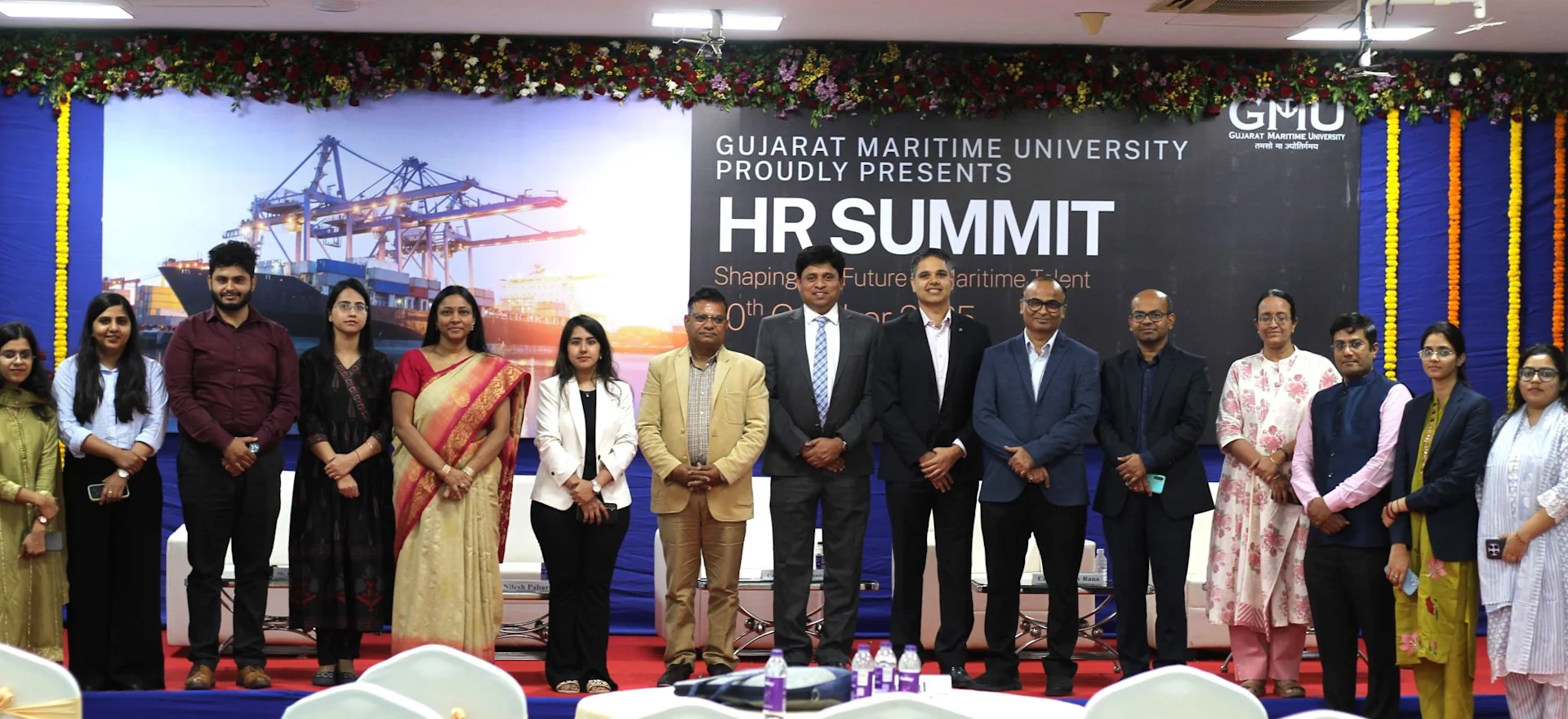
In October 2025, I had the privilege of joining the Gujarat Maritime University HR Summit for a panel discussion on the unique challenges shaping leadership, innovation and management in the blue economy.
The session brought together industry and academia to examine how maritime organisations must respond to rapid shifts in technology, sustainability and workforce expectations. Engaging with students, faculty and fellow panellists reinforced a clear message: continuous learning and reinvention are no longer optional, they are central to career progression and sector resilience.
My article below focuses on my key takeaways from the discussion, how human resources and structured talent development can drive long-term, responsible growth across the maritime domain in India and beyond.
A defining decade for maritime
The maritime industry is entering one of the most significant transitions in its history.
Digitalisation is changing vessel and port operations. Decarbonisation is redefining fuel strategies and compliance frameworks. Geopolitical shifts are influencing trade routes and supply chains. Customer expectations now extend beyond delivery to transparency and sustainability.
At the centre of this transformation lies a single factor: maritime talent.
Infrastructure can be upgraded. Technology can be installed. Regulations can be enforced.
Sustainable growth in the blue economy will depend on how effectively we develop, empower and lead our people.
The Blue Economy: opportunity with responsibility
The blue economy extends beyond maritime trade. It includes offshore energy, subsea operations, marine sustainability, smart ports and digital logistics corridors.
With this expansion comes responsibility.
Organisations must balance economic resilience with environmental accountability. At the same time, they face increasing complexity in leadership, innovation and workforce readiness.
Operational excellence alone is no longer sufficient. Maritime organisations must strengthen their human capital strategy if they want to remain competitive.
The challenge is not simply scaling operations. It is scaling capability.
Leadership in a changing operating environment
The sector faces a combination of pressures that are both global and highly specialised.
Environmental and safety regulations continue to tighten. Leaders must understand policy implications while managing operational realities.
Energy transition is accelerating. Alternative fuels demand new technical knowledge and new managerial discipline.
Automation and AI are expanding across ports and fleets. The core issue is not technology adoption. It is talent adaptation.
Global workforce mobility remains a defining feature of maritime operations. Managing diverse, geographically dispersed teams requires cultural fluency and emotional intelligence.
In this environment, traditional command and control leadership models are under strain. The industry requires adaptive leadership grounded in resilience, innovation and accountability.
From training skills to building capability
Future ready organisations move beyond skill-based training. They focus on capability development.
This means developing leadership pipelines early in careers. It means encouraging cross functional exposure, so professionals understand the broader operational ecosystem. It means embedding sustainability awareness into day-to-day decision making.
Empowerment is not delegation. It is the deliberate creation of environments where individuals take ownership and continue learning.
In my experience across the Asia, Middle East, and Africa regions, organisations that invest strategically in workforce development demonstrate stronger operational consistency and higher safety performance. Their leaders make clearer decisions. Their teams respond more effectively under pressure.
Customer confidence follows internal strength.
Today’s clients expect reliability, transparency and responsible execution. Technical competence forms the baseline. Leadership behaviour defines the experience.
Structured coaching and scenario-based learning strengthen crisis management, communication and judgement. When supervisors lead well, service quality becomes embedded within the organisation’s culture.
Customer satisfaction is ultimately a reflection of internal capability.
Building the ecosystem for future maritime talent
Human Resources must no longer function as a transactional department. In the modern maritime ecosystem, HR is a strategic architect of growth.
HR leaders must align workforce planning with digital and decarbonization strategies, identify future skill gaps before they impact operations, design structured competency frameworks, and foster diversity, inclusion, and global mobility.
Sustainable growth in the maritime sector cannot occur without strategic talent architecture. The organisations that will lead the Blue Economy are those that treat human capital as an investment, not an expense.
Strengthening university industry engagement
One of the most critical priorities for the future is deeper collaboration between academia and industry. Bridging the gap between theoretical education and operational reality requires industry integrated curriculum, live project exposure and internships, mentorship from seasoned maritime professionals, and joint research on sustainability and digital transformation.
Universities play a foundational role in shaping maritime mindsets. Industry must actively participate in guiding this development to ensure relevance and readiness.
The future workforce must graduate not only with certifications, but with leadership awareness, adaptability, and innovation capability.
A collective responsibility
The maritime sector has always been resilient. It has navigated wars, economic crises, technological revolutions, and global disruptions.
Yet the coming decade will test us in new ways.
Shaping the future of maritime talent requires visionary leadership, innovation-driven cultures, structured talent development, strong university industry partnerships, and HR strategies aligned with long term sustainability goals.
The Blue Economy is not simply about expansion; it is about responsible stewardship.
As maritime leaders, we must recognize that our greatest asset is not our fleets, terminals, or technologies. It is the people who operate them.
The question is simple: are we developing maritime leaders fast enough to keep pace with the transformation we are demanding of them?