Leadership Development – the missing conversation of the maritime transition
May 2026

Olav Vorup Jensen
Principal Consultant and Leadership SME

Dr. Joanna-Eugenia Bakouni
Learning & Development Manager - Maritime
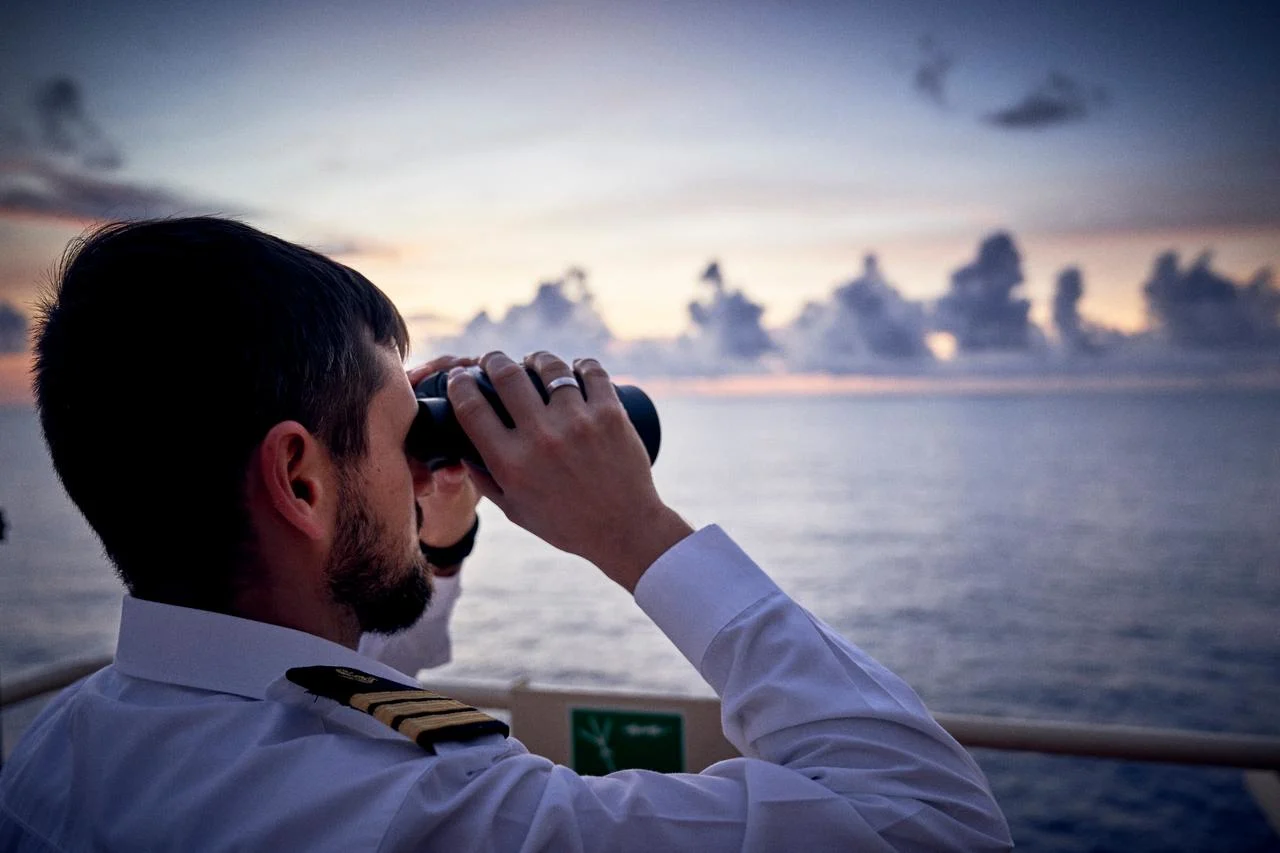
Maritime has always been an industry that values the people who can do the job. Technical excellence is how trust is built, and how careers are made. That is one of the sector's strengths, and it is also where a familiar pattern sits.
The industry tends to promote its strongest technical operators into leadership roles, and to leave much of the rest to experience. As the pace of change accelerates, that approach is becoming a quiet but serious risk.
The leadership conversation maritime keeps avoiding
In this industry, there is a pattern that has held for decades. The best engineer becomes the chief engineer. The most capable officer becomes the master. The most reliable performer ashore moves into a fleet or operations leadership role. The logic is familiar, and on the surface, it makes sense. Technical credibility matters in an industry where decisions carry real consequences.
But somewhere along that path, an assumption takes hold. The assumption that strong technical performance will naturally translate into strong leadership. It does happen, but rarely on its own.
This is the conversation the industry tends to avoid.
In most cases, we promote people based on what they have done well, then expect them to succeed at something quite different. The skills that build a great technical operator, including precision, focus, command of detail, the ability to work problems alone under pressure, are not the same skills that build a great leader. Leadership requires something else. It requires the ability to influence rather than instruct, to create clarity for others, to develop people rather than solve problems for them, to hold a steady tone when conditions are not steady. These capabilities are learned, not inherited from a technical career.
The pattern is well documented outside our sector too. A 2019 study published in the Quarterly Journal of Economics, looking at over 131 companies and more than 1,500 promoted to managerial positions, found that the best individual performers were the most likely to be promoted into management, and the least likely to perform well once they got there (Benson et al., 2019). The mechanism is straightforward. Technical excellence in a functional role does not transfer automatically to the relational, strategic, and accountability-oriented demands of leading people, yet the promotion decision is almost always made on the basis of functional performance. Maritime is not immune to this. If anything, our deep technical culture makes it more likely.
What follows is predictable. New leaders default to what they know. They lead by doing, by checking, by stepping in. They manage tasks rather than develop teams. Many adapt over time, often through hard experience. For others, the transition stays difficult, and the cost is absorbed quietly across crews, vessels and shore teams. It shows up in turnover, in safety culture, in the way information moves or fails to move during incidents, in the slow erosion of psychological safety on board.
Research on maritime education echoes this pattern. The well-cited Hetherington, Flin and Mearns (2006) review in the Journal of Safety Research linked accidents in shipping not primarily linked to technical failure but to human factors such as communication, decision making, situational awareness and leadership. More recent work (e.g. Fjeld et al., 2018; Saeed et al., 2017) continues to point gaps in non-technical and leadership capability, particularly in the transition from technical roles to senior officer and shore-based positions. The industry knows the gap exists. The question is whether it is yet treating it with the same seriousness it applies to technical and regulatory competence.
An industry changing faster than those leading it
Maritime is changing faster than at any point in living memory. Decarbonisation timelines are tightening, with the IMO's Net-Zero Framework targeting near-zero greenhouse gas emissions by around 2050 and the EU's FuelEU Maritime regulation now in force. Alternative fuels, such as methanol, ammonia, hydrogen, bio-LNG, are entering operational service. Autonomous and remotely operated systems are slowly but steadily moving from pilot projects toward mainstream use. Digitalisation is reshaping bridge operations, fleet management, and shore-based decision-making. The workforce is shifting in age, expectation, and composition.
The numbers behind the workforce shift deserve attention. The BIMCO and ICS Seafarer Workforce Report has consistently flagged a widening gap between supply and demand for STCW-qualified officers with shortages projected in the tens of thousands, and management-level officers among the most affected categories. At the same time, a recent HELMEPA-led survey (2025) found that 64% of seafarers in the Eastern Mediterranean had received no decarbonisation training the previous two years.
The industry has responded with significant investment. New vessels, new fuels, new technology, new digital platforms. Capital is flowing into assets and systems with a clear expectation that they will deliver competitive advantage and regulatory compliance.
Yet the same level of investment is not always reaching the people who are expected to lead through this change. Leadership development is often layered on top of operational demands, delivered through experience or through short interventions, when there is time. The result is a widening gap between the complexity of the operating environment and the leadership capability available to navigate it.
A new dual-fuel vessel can be ordered, financed, built, and delivered in less time than it takes to develop a leader who can run it well. That imbalance is worth sitting with. The hardware will arrive on schedule. The leadership will not, unless the industry is deliberate about it.
What maritime can learn from other industries
There is no shortage of high-risk industries that have faced this same question and approached it differently.
Aviation is the most cited example, and for good reason. Following a series of serious accidents in the late 1970s , including the 1977 Tenerife disaster and the 1978 United Airlines flight 173 crash, where root causes were traced to ineffective teamwork, poor communication, and weak leadership in the cockpit rather than technical failure NASA convened a workshop in 1979 that became the foundation of Crew Resource Management (CRM). CRM is now embedded in how pilots, cabin crew, and increasingly maintenance teams are trained, assessed, and developed throughout their careers. It treats non-technical skills, including leadership, situational awareness, decision-making, assertiveness, teamwork , as core competencies rather than personal traits. Most major airlines and civil aviation regulators now mandate it.
Maritime has borrowed from this through Bridge Resource Management and Engine Room Resource Management, both reflected in the STCW 2010 Manila Amendments. That is real progress. It is also worth being honest that the evidence on BRM effectiveness is more mixed than aviation CRM. Studies in the WMU Journal of Maritime Affairs and elsewhere show that BRM training improves knowledge, but its impact on observable non-technical skills or real-world vessel-command performance (Röttger et al., 2016). Hjelmervik and colleagues (2018), reviewing the wider CRM-in-maritime literature in the same journal, concluded that learning outcomes suffer when training programmes are imported from aviation without proper adaptation to the maritime context. The takeaway is not that BRM has failed. It is that a short classroom course, every five years, on its own, is not the same thing as a sustained leadership development system."
Oil and gas, particularly offshore, made a similar shift after Piper Alpha in 1988. The Cullen Inquiry found that the offshore installation manager had not received the training needed to handle the emergency, and the recommendations that followed reshaped how OIMs are selected, trained, and assessed. Today, OIM development includes formalised emergency management programmes, simulator-based assessment, structured shadowing of incumbent OIMs, and recurrent competence checks. Behavioural leadership and human factors became part of how supervisors were prepared, not something they were expected to absorb on the job. CRM principles have since been adopted across the offshore sector.

Healthcare, in the most progressive systems, has worked to separate clinical excellence from leadership progression. A surgeon is no longer assumed to be the right person to lead a department simply because they are the strongest clinician. Leadership is increasingly treated as its own discipline, with its own development path, its own assessment criteria, and its own succession planning.
The common thread across these examples is a willingness to challenge a long-held assumption. Technical mastery is necessary but not sufficient. Leadership has to be developed on purpose, and in most cases, it took a serious incident to force the change.
Maritime has had its own incidents and its own lessons. The industry already understands risk. It already understands the cost of getting it wrong. It already invests heavily in technical competence and certification through STCW and beyond. The infrastructure for serious development exists. What deserves the same level of intentionality is leadership development itself.
A different starting point
None of this is a criticism of those who have come up through the technical route. They are, in many cases, the foundation of the industry. The question is not whether they should lead. It is whether the industry is doing enough to prepare them to lead well, and to keep developing them as the operating environment grows more complex.
That preparation does not need to be elaborate. It starts with treating leadership as a real capability, with real development behind it. In practice, that looks like a few specific things. Identifying leadership potential separately from technical performance, before promotion rather than after. Building structured development pathways that combine coaching, peer learning across functions and across companies, simulator-based and scenario-based assessment of non-technical skills, and recurrent refreshers rather than one-off courses. Giving leaders space to reflect and to be challenged on their assumptions. And measuring leadership outcomes the way we measure operational ones, including retention, psychological safety, near-miss reporting, and the quality of decision-making in pressure situations.
The investment is modest compared to the cost of a new vessel or a new system. The return tends to compound, because leadership shapes how every other investment performs.
Key question to explore further
If the industry is willing to invest heavily in new technology and new assets, what is holding it back from investing with the same seriousness in the leaders who will determine whether any of it works?
References
Benson, A., Li, D. and Shue, K. (2019). Promotions and the Peter Principle. The Quarterly Journal of Economics, 134(4), 2085-2134.
Boman, K., (2018). Piper Alpha 30th anniversary: Industry must not let complacency set in, lessons learned be forgotten, The Drilling Contractor, Available at: https://drillingcontractor.org/piper-alpha-30th-anniversary-industry-must-not-let-complacency-set-in-lessons-learned-be-forgotten-47377 Last Accessed: 6 May 2026
European Commission (n.d.) Decarbonising maritime transport – FuelEU Maritime , available at:https://transport.ec.europa.eu/transport-modes/maritime/decarbonising-maritime-transport-fueleu-maritime_en Last Accessed: 6 May 2026
Fjeld, G. P., Tvedt, S. D. and Oltedal, H. (2018). Bridge officers' non-technical skills: a literature review. WMU Journal of Maritime Affairs, 17(2), 475-495.
Global Maritime Forum (2026). A guide to the IMO's Net-Zero Framework, Global Maritime Forum, available at: https://globalmaritimeforum.org/news/a-guide-to-the-imos-net-zero-framework/ Last accessed: 6 May 2026
HELMEPA (2025). Survey highlights uneven but advancing decarbonization in Eastern Mediterranean shipping, Available at: https://www.helmepa.gr/post/survey-highlights-uneven-but-advancing-decarbonization-in-eastern-mediterranean-shipping Last accessed: 06 May 2026.
Helmreich, R. L., Merritt, A. C., & Wilhelm, J. A. (1999). The evolution of Crew Resource Management training in commercial aviation. The International journal of aviation psychology, 9(1), 19–32.
Hetherington, C., Flin, R. and Mearns, K. (2006) Safety in Shipping: The Human Element. Journal of Safety Research, 37, 401.
Hjelmervik, K., Nazir, S. and Myhrvold, A. (2018). Crew resource management training in the maritime industry: a literature review. WMU Journal of Maritime Affairs, 17(4), pp. 1-20
Röttger S., Vetter S., Kowalski J. T. (2016). Effects of a classroom-based bridge resource management training on knowledge, attitudes, behavior and performance of junior naval officers. WMU Journal of Maritime Affairs, 15(1), 143-162.
Saeed, F., Wall, A., Roberts, C., Riahi, R. and Bury, A. (2017). A proposed quantitative methodology for the evaluation of the effectiveness of Human Element, Leadership and Management (HELM) training in the UK. WMU Journal of Maritime Affairs, 16(1), 115-138.