Preparing crews for legal and personal risks, not just physical threats
June 2026

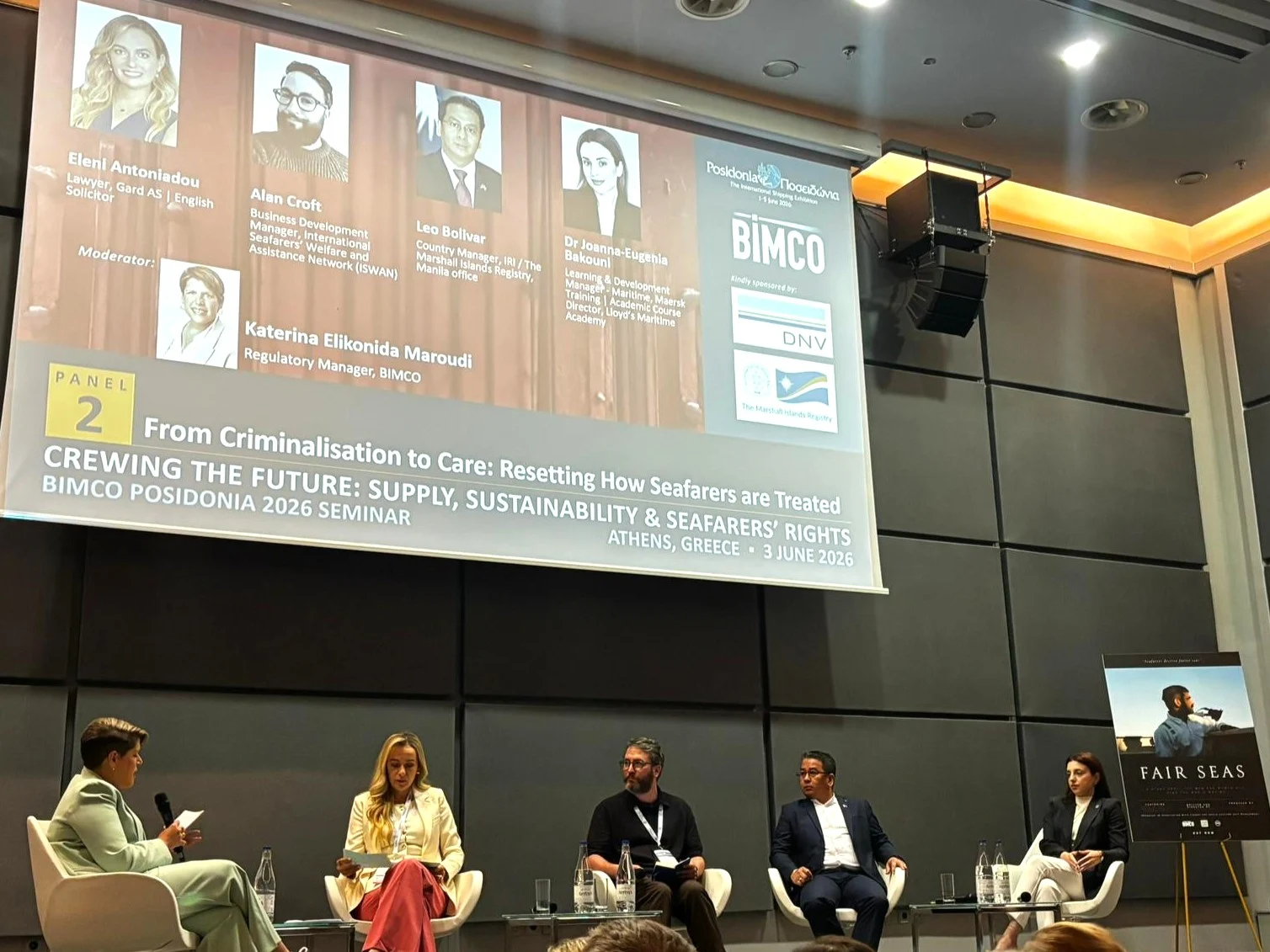
At Posidonia this June 2026, I was honoured to be invited to BIMCO’s seminar as a speaker about a subject most of us would rather not think about: what happens to a seafarer when an ordinary day at work turns into a detention, an investigation, or a criminal charge.
The room was full of people who care deeply about this: crew managers, industry trainers, lawyers, flag state representatives, welfare specialists. And yet the thing that stayed with me afterwards was not a point of law. It was a simple, uncomfortable gap between what we say we provide and what a frightened crew member can actually reach for at three in the morning.
My main point in this discussion was addressing this gap, from a training provider’s perspective. We are very good at preparing seafarers for physical danger. A deck cadet can tell you what to do in a fire, how to abandon ship, how to respond to a man overboard, because we practice those drills until they become instinct. Ask that same person what they should say, or not say, in the first hour after their vessel is boarded and they are suspected of a crime they may not have committed, and you will often get silence. We have built muscle memory for emergencies that threaten us physically and almost none for the ones that threaten a person's liberty, livelihood, and sense of self.
Guidelines alone do not reach the person who needs them
This matters more now than it did a few years ago. The Round Table of International Shipping Associations has warned of a rise in unjust treatment and criminalisation of seafarers, and reliable data on drug-related detentions in particular remains thin, which is part of the problem. Seafarers continue to be the easiest party to blame when something goes wrong. Older survey work by Seafarers' Rights International found that a striking share of masters had faced criminal charges at some point, and that most seafarers who did faced them without legal representation or interpretation. Whatever the precise figures today, the direction of travel is not reassuring.
There has been real progress on paper. In 2025 the IMO Legal Committee adopted new Guidelines on the fair treatment of seafarers detained in connection with alleged crimes, developed through the Joint ILO-IMO Tripartite Working Group. They set out sensible principles: due process, protection from coercion, and the expectation that wages, medical care and repatriation continue while proceedings run their course. But we should acknowledge that guidelines are not self-executing. A document on a website does not help an officer who does not understand what is happening to them, in a language they barely follow, when the people questioning them hold all the power in the room. So in that sense, the gap is not the policy. The gap is whether the policy has reached the person who needs it, before they need it.
This is where my own field, learning and development, has to be honest with itself. Compliance training answers one question well: what is the rule? But the situations we touched upon this panel are precisely the ones where the rule runs out. A seafarer facing detention is not struggling because they forgot a regulation. They are struggling because nobody prepared them for the fear, the isolation, and the weight of a decision with no clean answer. And you cannot tick-a-box your way out of that kind of readiness. When people fail in these moments, it is usually not for lack of knowledge. It is because we trained them to pass an assessment and then sent them into an experience we never rehearsed.
Three shifts beyond compliance
So what would moving beyond compliance actually look like? For me it rests on three shifts (and none of them is exotic).
-
The first is training judgement rather than only knowledge. That means realistic scenarios with ambiguity and time pressure, and the freedom to make a poor decision in a safe room rather than a real one. The learning lives in the reflection afterwards, in the unhurried conversation about why someone reached for the answer they did.
-
The second is treating psychological resilience as a competence we build, not a personality trait we assume. The industry has quietly relied for too long on the idea that good seafarers simply cope. The mental health evidence should put that comfortable assumption to rest. Gard's 2025 Crew Claims Report found that the number of suicides among crew exceeded the number of fatal accidents, with many cases occurring early in contracts and a disproportionate number among officers, the very people we ask to lead. Earlier research for the ITF Seafarers' Trust found that a quarter of seafarers surveyed reported symptoms of depression and one in five had experienced suicidal thoughts. Supporting the individual, and looking hard at the conditions, workload and culture around them, is a strategy we should focus on (rather than trying to “fix” the individual).
-
The third shift is the most practical, and it is the one I would prioritise. I would make incident readiness a trained, rehearsed and assessed standard for every seafarer and every shore-based team, in the same way safety drills already are. Concretely: every seafarer should know, before they ever need it, what their rights are, who to contact, what to say and what not to say, and that their company will stand behind them. Not buried in a manual. At the Posidonia panel, a colleague from ISWAN made the case for a simple emergency pack covering exactly this, and I think that kind of plain, portable tool is worth far more than another well-meaning policy document. Every shore team, equally, should have rehearsed the first twenty-four hours of a detention, because that is when the human damage is done and when good support changes the outcome. And it should be assessed, because anything we choose not to assess, we quietly tell people does not really matter.
Make incident readiness a trained, assessed standard
There is a reasonable objection here, and I want to acknowledge it rather than dodge it. Training cannot fix a hostile jurisdiction, an unfair prosecution, or a shipowner who walks away. It would be dishonest to suggest otherwise, and the regulatory and diplomatic work has to continue in parallel. But readiness training does something regulation cannot do on its own. Regulation moves at the speed of consensus. An incident moves at the speed of an incident. The guidelines tell governments what fair treatment should look like. Readiness tells the seafarer, in the moment that matters, that they are not alone, that they know what to do, and that someone has their back. That is the difference between a crew member who feels abandoned and one who feels held.
We have spent decades getting very good at protecting seafarers from the sea. The harder, less glamorous task of the next decade is getting just as good at protecting them from everything else that can go wrong. That work starts with preparation, not paperwork, and it is well within our gift to begin now.
For more information on the BIMCO Posidonia 2026 Seminar, visit this page.
Sources consulted
-
BIMCO (2025a) Shipping organisations increasingly concerned about seafarer safety. Available at: https://www.bimco.org/news-insights/press-media/press-releases/2025/20250207-seafarer-safety/ (Last Accessed: 19 June 2026).
-
BIMCO (2025b) Guidelines for Fair Treatment of Detained Seafarers adopted by IMO's Legal Committee. Available at: https://www.bimco.org/news-insights/bimco-news/2025/03/31-detained-seafarers/ (Last Accessed: 19 June 2026).
-
Gard (2025) Gard Crew Claims Report 2025: Key trends in seafarer health and safety. Available at: https://gard.no/en/about-gard/company-news/gard-crew-claims-report-2025-key-trends-in-seafarer-health-and-safety/ (Last Accessed: 19 June 2026).
-
International Labour Organization (2025) Guidelines on fair treatment of seafarers detained in connection with alleged crimes. Geneva: ILO. doi:10.54394/LLEI1217. Available at: https://www.ilo.org/resource/other/guidelines-fair-treatment-seafarers-detained-connection-alleged-crimes (Last Accessed: 19 June 2026).
-
International Maritime Organization (2025) IMO/ILO work on seafarer issues: Guidelines on fair treatment of seafarers detained in connection with alleged crimes (adopted by the Legal Committee, LEG 112). Available at: https://www.imo.org/en/ourwork/legal/pages/jointimoiloworkinggroupsonseafarerissues.aspx (Last Accessed: 19 June 2026).
-
ITF Seafarers (n.d.) Criminalisation. International Transport Workers' Federation. Available at: https://www.itfseafarers.org/en/resources/criminalisation (Last Accessed: 19 June 2026).
-
Khodayari, S. (n.d.) Seafarers' Criminalization. London: The Nautical Institute. Available at: https://www.nautinst.org/static/6ce79d1d-77a8-4687-93502dc9d8b1f603/HE01095-Seafarers-Criminalization.pdf (Last Accessed: 19 June 2026).
-
Lefkowitz, R.Y. and Slade, M.D. (2019) Seafarer Mental Health Study: Final Report. London: ITF Seafarers' Trust and Yale University. Available at: https://www.seafarerstrust.org/sites/default/files/node/publications/files/ST_MentalHealthReport_Final_Digital-1.pdf (Last Accessed: 19 June 2026).